
India's real estate market is poised for growth across categories - residential, commercial, and rental. Currently valued at Rs 24 trillion, or about $300 billion, it is projected to surge to $1.3 trillion by 2034, and then grow further to $5.17 trillion by 2047, indicates a report by the Confederation of Real Estate Developers Associations of India (Credai).

A businessman in Navi Mumbai is accused of defrauding four investors of Rs 28.4 lakh through a forex trading scheme promising high returns.

There's no place like home, but even for the affluent buying one in India is difficult. On top of that, the coronavirus pandemic-now in its eighteenth month-has made life uncertain. A hopeful thing is buying a house looks alluring as loan interest rates fall below 7 per cent, their multi-decadal lows. The slow decline in GDP growth after demonetisation, followed by the economic shock caused by Covid-19 waves, has hurt us unevenly.

Buying one's dream home requires planning, funds, and these days, putting on an AI-enabled virtual reality (VR) headset. Realtors are increasingly providing customers an immersive experience, courtesy generative artificial intelligence (GenAI), mixed reality, and metaverse. For realty consultancy Anarock group, AI and machine learning (ML) are enabling predictive market analysis, facilitating virtual property tours, and improving property management through predictive maintenance.

The CBI conducted searches at 77 locations across eight states, registering 22 new cases related to a nexus between builders and financial institutions, allegedly defrauding homebuyers.
In the second part of this series that identifies fastest emerging real estate hotspots in India, Estatelister.com explains why Kharadi, close to Pune Airport in Maharashtra, is emerging as a new investment hub.

If the real estate sector is properly managed, it could drive not just finance but demand for a range of products and services, observes T N Ninan.

The real estate sector wants "high-impact" measures, like special schemes and tax breaks for developers, to revive the fortunes of the affordable housing segment in the country, multiple executives told Business Standard. This segment has been struggling since the Covid-19 outbreak, in contrast to larger and costlier homes which have been selling like hot cakes. The demand comes at a time when the government is taking suggestions from industry players before tabling the General Budget in the Parliament next month.

Escalating geopolitical tensions in West Asia are prompting investors with exposure to Dubai's real estate market to reassess their portfolios. And, in this rejig, India is emerging as a stable destination for capital investment and long-term growth.

Avoid builders with very large commitments.
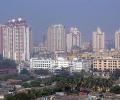
Here's what's buzzing in Mumbai if you are looking out for real estate appreciation...

Housing sales fell 6 per cent in April-June to 90,715 units across seven major cities on subdued demand amid economic uncertainties and also rising home prices, according to Anarock data released on Monday. As many as 96,285 units were sold in the year-ago period across the top seven cities -- Mumbai Metropolitan Region (MMR), Delhi-NCR, Pune, Bengaluru, Hyderabad, Chennai and Kolkata.

Also, LBS Marg provides easy accessibility to other parts of Mumbai.

India's leading conglomerates are stepping up investments in real estate, recasting what was once a peripheral activity into a core growth driver. Supported by strong balance sheets, established brands and access to long-term capital, major business houses including Aditya Birla, Tata, Godrej, L&T, Raymond, Wadia, Shapoorji Pallonji, Mahindra and Adani are positioning realty as a strategic pillar within their diversified portfolios.

India's leading listed real estate developers are increasingly focusing on pan-India expansion, diversifying beyond their traditional home markets into high-demand residential areas like MMR, NCR, Bengaluru, Hyderabad, Pune, and Chennai to tap broader housing demand and reduce reliance on single-city market cycles.

Bharti Airtel added 7.64 trillion in value over the past five years, making it the biggest wealth creator in India's private sector, while the IT sector, including TCS, Infosys, and Wipro, collectively lost 8.5 trillion in value, according to the latest Burgundy Private Hurun India 500 report.

The industry describes projects priced beyond Rs 5 crore (Rs 50 million) in Delhi and the National Capital Region region as luxury, but the benchmark is Rs 10 crore (Rs 100 million) for Mumbai.
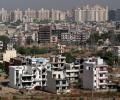
The total demand has remained subdued mainly due to high interest rates and property prices.

As real estate is about a tenth of the Indian economy, the extent of black money floating around in the sector is huge.
Platform-style partnerships between global investors and Indian developers are expected to gain further traction over the next few years. This comes as institutional capital increasingly shifts from one-off asset acquisitions to scalable, long-term strategies.
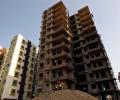
The average home prices in Mumbai have touched Rs 12,000 per sq ft

The Supreme Court of India has issued a strong warning against the use of "non-existent, fake, and hallucinated" judgements generated by artificial intelligence (AI), likening it to "the release of methyl Isocyanate in the province of law and justice: invisible, insidious, and catastrophic." The court set aside an NCLT verdict that relied on such AI-generated precedents.

After years of living with his family in a poky 110 sq. ft. 'house', textile worker Sambhaji Surve dreams of moving into a home four times the size once the Maharashtra government starts its ambitious redevelopment of the 39-acre Kamathipura shanty town in south-central Mumbai. Sharing his dream are about 8,000 other families hoping for a better life when the redevelopment project, part of the government's effort to redevelop old settlements and make life more livable for some residents, gets underway. The Shiv Sena-Nationalist Congress Party aims to redevelop BDD Chawl and Dharavi but for Surve all the matters is Kamathipura where he arrived in the 1970s from Nasik to work in a textile mill. Kamathipura was originally built 150 years ago following construction of a causeway to connect the seven islands of Mumbai. From the British Raj to post-independence, it became infamous for slums and brothels.

Gurugram has overtaken Mumbai to become India's biggest luxury housing market in 2025, recording 24,120 crore in sales of homes priced above 10 crore.

Demonitisation will facilitate transparency in the real estate industry, which has had a notorious reputation as a safe locker for black money, says Saket Mohta.

Telecom major Reliance Communications plans to monetise its real estate assets as it looks to pare debt.
Greaves Cotton, for instance, has converted half its holding into commercial real estate (a multiplex) while Elpro plans to follow suit by developing half its 37-acre land at Chinchwad.

PE funds have invested Rs 13,000 cr into the property market in Bengaluru.

In opaque, complicated markets like real estate, its best to stay away from generalisations.
We must not allow another cycle of crazy price rises to set in. Or land banking to become the next new hot industry.

Sapne vs Everyone is dark, and often depressing. At the same time, it is not completely hopeless, notes Deepa Gahlot.

The ongoing West Asia conflict is expected to severely impact the supply of affordable housing in India, as rising input costs further erode already thin developer margins. Fluctuations in crude oil and gas prices, coupled with higher freight costs, are driving up prices of essential construction materials like cement and steel, making new projects increasingly unviable for developers.
Indian property market and its regulations need to be reformed further to attract foreign direct investment while the demand for space for business process outsourcing is expected to cross over two crore square feet in the next three-five years.
Analysts have turned bullish after success of some big launches and revival of home sales. There is optimism on rate cuts by RBI and hope for lower inflation; which may renew buyers' interest in real estate in coming months.

After a long time, real estate companies could hit the fund-raising trail. The reason is improvement in investor sentiment.
Siddhesh Joglekar, founder of Estatelister.com lists out reasons why these five cities could emerge as the best real estate investments in the New Year.

'The inflection point that really happened in the sector was during the pandemic when buyers' perception changed towards consumption and that gave a trigger to pent-up demand with the increased affordability.'

Leading diamond jewellery manufacturer and retailer Gitanjali Gems Ltd is entering into real estate business through its maiden residential project at Borivli, in Mumbai's western suburb.
'The government has to stop trying to fix things for lenders, projects, homeowners and developers and think instead about how to fix the market for houses,' says Mihir S Sharma.
